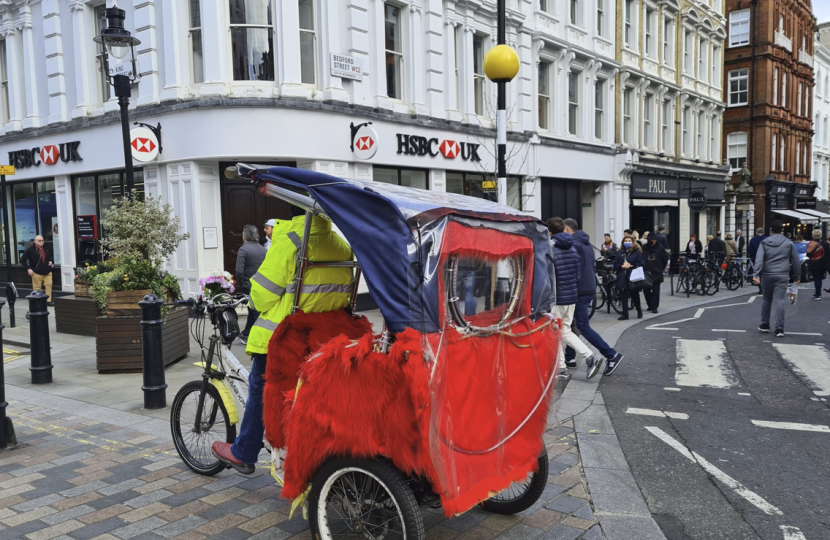
Pedicabs in London – The Facts
Conservatives delivered the powers to regulate pedicabs in 2024. Labour dragged its feet on acting and left local people and businesses to suffer for years.
New Regulations Announced
On Wednesday, 18 February 2026, Transport for London (TfL) announced that pedicab regulations will now be introduced and enforced in stages over the coming year.
For the first time, pedicabs in London will be properly regulated using powers introduced by the Conservative Government in 2024.
New measures include:
- A ban on external audio from pedicabs
- Maximum journey fares to ensure fair and transparent pricing
- Licensing requirements for drivers, vehicles and operators
- Safety and insurance standards
Transitional arrangements will allow drivers time to apply for licences, with maximum fares coming into force later this year.
These regulations were only possible because of legislation passed under the previous Conservative Government through the Pedicabs (London) Act 2024.
The Act was brought forward by former Cities of London & Westminster Conservative MP Nickie Aiken and received Royal Assent in April 2024, giving TfL the legal powers to regulate pedicabs for the first time.
Why Was Legislation Needed?
For years, pedicabs operated in a legal loophole.
Under Section 4 of the Metropolitan Public Carriage Act 1869, pedicabs were classified as “stage carriages” in Greater London. As a result:
- They did not fall under TfL’s taxi and private hire licensing powers
- There were no mandatory insurance requirements
- Fares were not regulated
- Vehicle safety standards were not enforced
- Driver suitability checks were not required
London was the only city in England where pedicabs operated without a modern licensing regime.
Meanwhile, licensed taxi and private hire drivers were required to meet strict safety, insurance and fare transparency standards.
To fix this imbalance, primary legislation was required. The Pedicabs (London) Act 2024 granted TfL the necessary powers.
Legislation Timeline
2020: Nickie Aiken introduces a Private Member’s Bill to regulate pedicabs. It falls due to Parliamentary time constraints. This followed a Bill in 2018 presented by Conservative MP, Paul Scully.1
2021: The Bill is reintroduced but again falls due to procedure.2
2022: A Transport Bill including pedicab regulation is announced, but does not proceed in that form.3
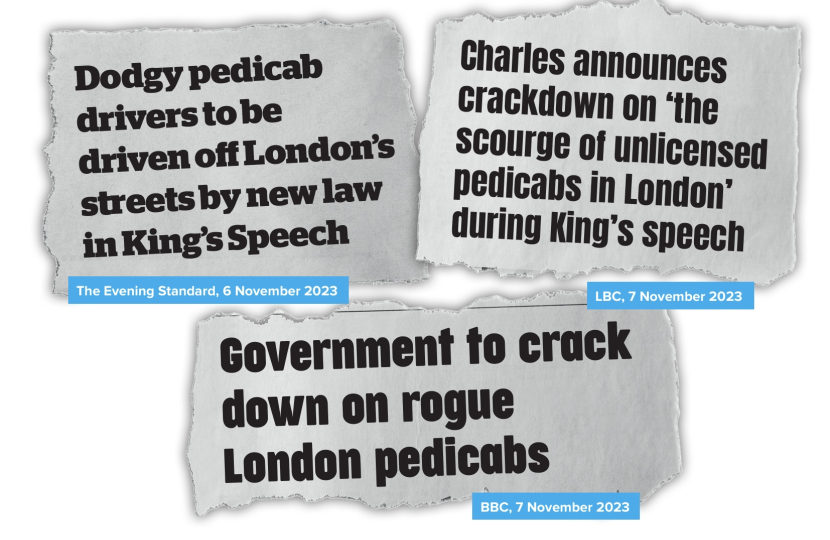
November 2023: A standalone Pedicabs Bill is announced by His Majesty The King during the State Opening of Parliament.4
November 2023 – April 2024: The Bill progresses through Parliament.
April 2024: The Pedicabs (London) Act 2024 receives Royal Assent.5
January 2025: TfL launches its first statutory consultation on implementing the Act.6
June 2025: TfL publishes consultation results, showing strong support for regulation.7
September 2025: A second consultation is launched to finalise detailed licensing proposals.8
October 2025: Second consultation closes.
18 February 2026: TfL confirms regulations will now be introduced.9
What Does the Pedicabs (London) Act Do?
The Act gives TfL powers to:
- License pedicab drivers
- License pedicab vehicles
- License operators
- Set and enforce fare caps
- Enforce safety and insurance standards
- Take action against non-compliant operators
If TfL gained powers in April 2024, why are they only regulating them now in 2026?
The Pedicabs (London) Act required TfL to undertake a formal public consultation before introducing regulations.
TfL could have begun that process shortly after Royal Assent in April 2024, but the consultation did not begin until January 2025. TfL then launched a second consultation in Autumn 2025, which was not required by the Act.
What Could Westminster City Council Do Before This?
Westminster City Council had very limited powers.
Though the Anti-Social Behaviour Crime and Policing Act 2014 provided limited useful power for the Council to use in reducing pedicab-related anti-social behaviour, this was only a short-term measure which required huge amounts of evidence, time, and resources.
In reality, the turnover of riders and locations meant it was very rare to take these cases to court and this kind of behaviour was left mostly unchecked.
The Council used Public Space Protection Orders to issue fixed penalty notices in specific circumstances, such as noise nuisance.
However, councils had no power to:
- License pedicabs
- Regulate fares
- Impose insurance requirements
- Enforce vehicle safety standards
Only an Act of Parliament could provide those powers.
- 1
https://www.nickieaiken.org.uk/news/bill-aims-proper-pedicab-regulation
- 2
https://www.nickieaiken.org.uk/news/nickie-aiken-mp-introduces-pedicabs-london-bill
- 3
https://www.nickieaiken.org.uk/news/breaking-new-laws-crackdown-rogue-pedicab-riders
- 4
https://www.instituteforgovernment.org.uk/explainer/kings-speech-2023
- 5
https://www.nickieaiken.org.uk/news/pedicab-licensing-becomes-law
- 6
- 7
- 8
- 9